Projects

Security engineering and detection engineering work: what each project does, what it is built with, and where to read more.

Compare projects Detection engineering overview

Compare project evidence

Review each project’s contribution, result and limitations.

Recorded lab study

Custom SIEM + Sentinel BAS

My contribution
Built the SIEM, Sentinel BAS simulations and alert-to-test matching.
Outcome
Seven simulations produced matching alerts; three did not. A missing parser field explained the Kerberoasting miss.
Recorded lab study

Active Directory Purple Team Lab

My contribution
Built the lab, reproduced the attack chain and documented defensive findings.
Outcome
Recorded Windows Security, Sysmon and OpenSSH evidence across the attack chain.

Active development

ARGUS

My contribution
Developing the assistant, V2 HUD, agent kernel, Windows skills, monitoring and backend security controls.
Outcome
Public Windows source release with voice, desktop workflows, bounded agents, a 3D state view and documented setup.
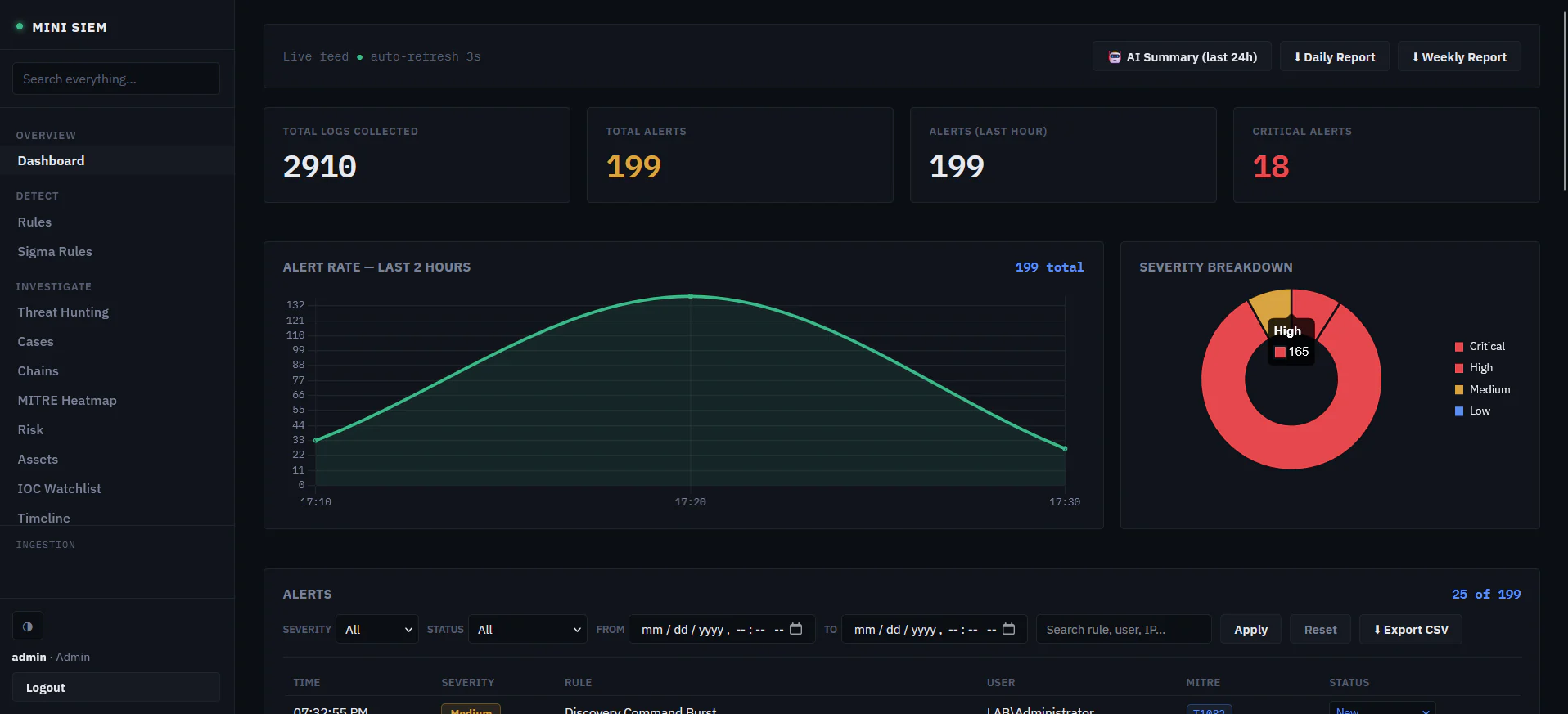
  • Custom SIEM dashboard with alert totals, alert rate over time and severity breakdown

    Detection engineering

    Custom SIEM + Sentinel BAS

    A custom Python SIEM paired with Sentinel BAS to validate detection rules, correlate alerts and investigate missed attack simulations.

    • Sigma
    • MITRE ATT&CK
    • Python

    Case-study summary

    Problem
    Validate whether controlled attack simulations generate the expected SIEM alerts.
    Architecture
    Windows/Linux collectors → Python/Flask → SQLite → Sigma, correlation and guarded SOAR.
    My contribution
    Built the SIEM, Sentinel BAS simulations and alert-to-test matching.
    Tests
    Recorded ten Atomic Red Team tests; matched alerts by technique, host and time.
    Outcome
    Seven simulations produced matching alerts; three did not. A missing parser field explained the Kerberoasting miss.
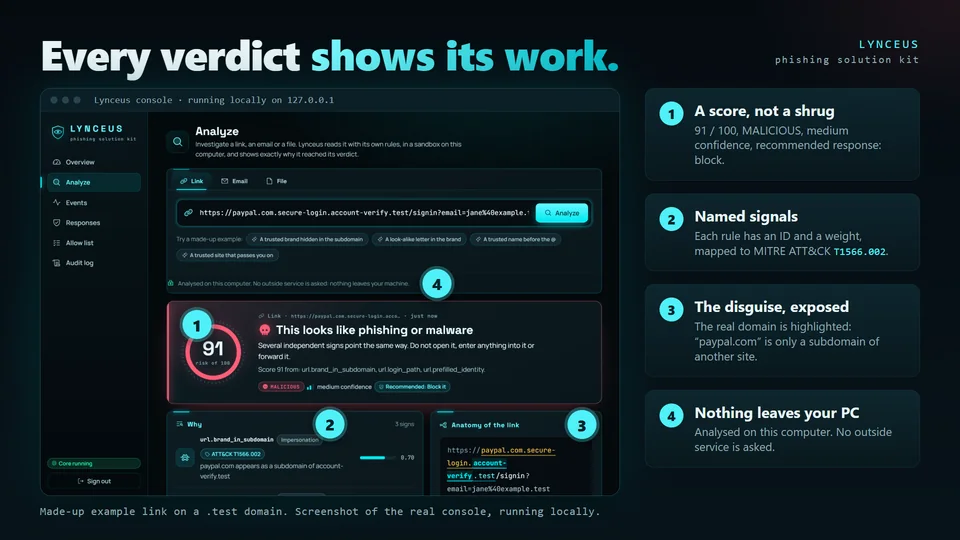
  • The Lynceus console analysing a made-up link on a .test domain: a risk score of 91 out of 100 marked malicious with medium confidence and a recommendation to block, the named signals with MITRE ATT&CK T1566.002, and the anatomy of the link with the real domain highlighted.

    Phishing detection, in development

    Lynceus

    Local-first phishing detection for Windows. Lynceus reads links, emails, files and, on request, the web page itself inside a sandbox on the user’s own computer, decides with its own rules, file hashes and a learned domain model that can only warn, and explains every verdict: the score, the signals behind it and the evidence. Nothing is sent to an outside service by default, and nothing it quarantines is ever deleted.

    • Python
    • FastAPI
    • C# (.NET 10)
    • TypeScript
    • React
    • Rust (Tauri 2)
    • PostgreSQL
    • Docker

  • Purple team lab

    Active Directory Purple Team Lab

    An isolated Active Directory lab exploring credential abuse, lateral movement and domain compromise, with documented telemetry and defensive analysis.

    • Active Directory
    • Sysmon
    • MITRE ATT&CK

    Case-study summary

    Problem
    Trace an intrusion from initial access to domain compromise and assess the available telemetry.
    Architecture
    Isolated Windows Server 2022 domain, member workstation and Kali attacker.
    My contribution
    Built the lab, reproduced the attack chain and documented defensive findings.
    Tests
    Controlled credential abuse, lateral movement, DCSync, Golden Ticket and SCP scenarios.
    Outcome
    Recorded Windows Security, Sysmon and OpenSSH evidence across the attack chain.

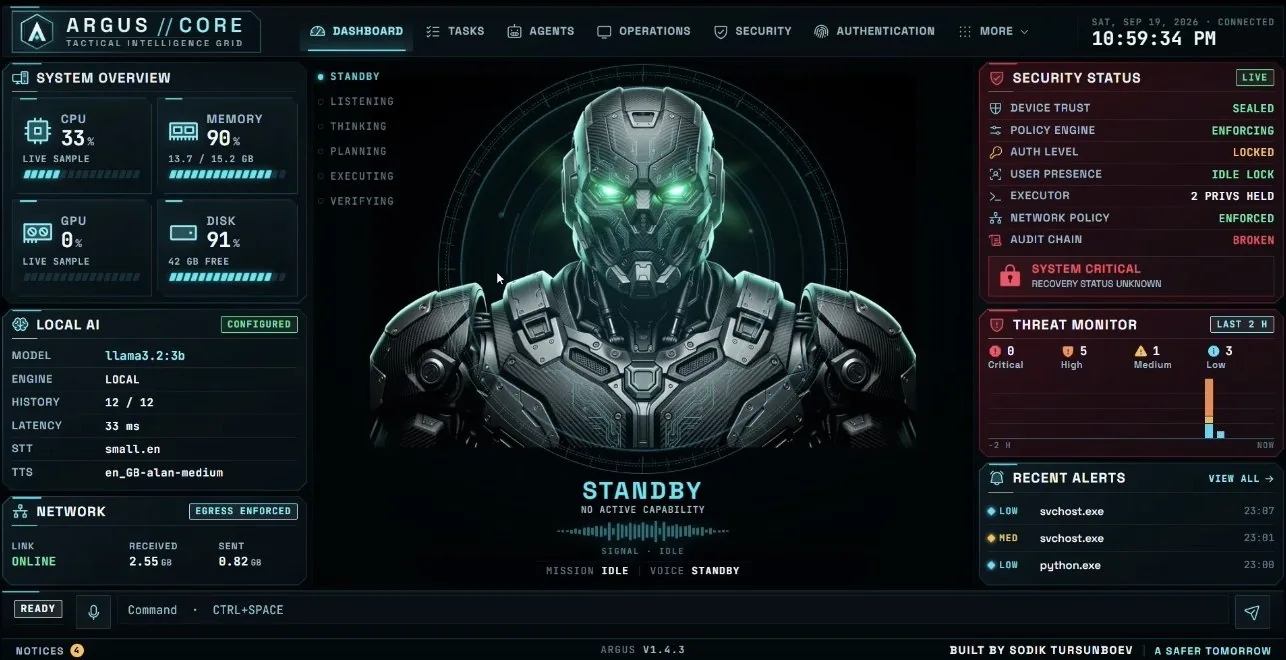
  • Recorded ARGUS interface from an earlier build; the current source uses the V2 Svelte HUD

    Security engineering

    ARGUS

    A Windows assistant in active development, combining voice and text interaction, bounded agent workflows and desktop automation with backend authorization controls.

    • Python
    • Svelte 5
    • FastAPI
    • Windows

    Case-study summary

    Problem
    Develop a Windows assistant with explicit separation between AI-generated proposals and permission to execute actions.
    Architecture
    Svelte 5 / TypeScript HUD → FastAPI REST and WebSocket service → routing, authorization, action-bound grants and registered skills; separate voice workers.
    My contribution
    Developing the assistant, V2 HUD, agent kernel, Windows skills, monitoring and backend security controls.
    Tests
    The case study references public source code and documentation. Current Windows runtime test results have not been independently verified.
    Outcome
    Public Windows source release with voice, desktop workflows, bounded agents, a 3D state view and documented setup.

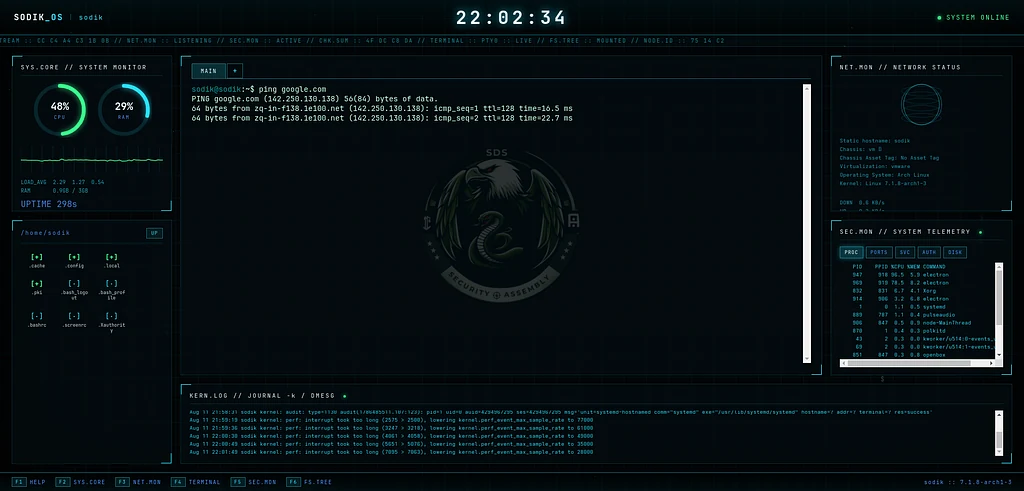
  • SODIK OS after boot: a system monitor, a live terminal, network status and security telemetry panels

    Operating system

    SODIK OS

    A bootable Arch Linux system with its own interface, a real root shell, live telemetry and an AI voice during startup.

    • Arch Linux
    • Electron
    • node-pty